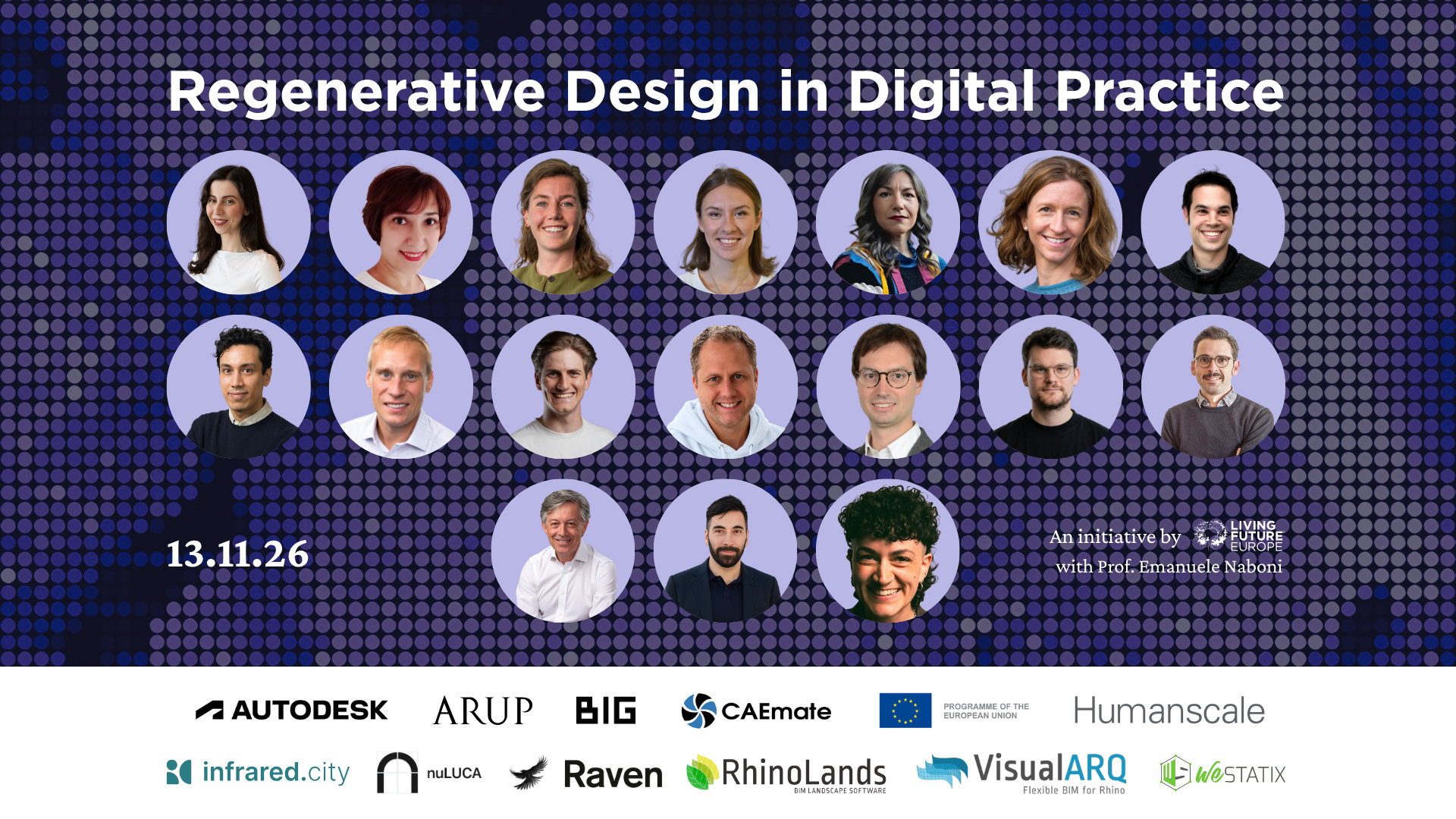
13 November 2026 | Online | 9:30 - 18:45 CET
Are you a design professional looking for a deeper regenerative framework to guide your work? Or a sustainability consultant seeking digital workflows, tools and case studies that can turn regenerative goals into practice?
On 13 November 2026 (online, full day), Living Future Europe, in collaboration with Prof. Emanuele Naboni, hosts a practitioner crash course exploring how digital tools can help translate regenerative ambitions into measurable, actionable design decisions.
Across the programme, leading practitioners and innovators will share the digital workflows, methods and case studies they use LIVE to follow, to address environmental performance, material impacts, climate resilience, biodiversity and other regenerative design goals. Each session connects tools to decisions, metrics and deliverables that you can apply directly in your practice or research.
Organised by: Living Future Europe
By the end of the course, participants will be able to:
Carlo Battisti | Living Future Europe
09:35–10:15: Emanuele Naboni | Opening Keynote | Decoding and Coding Regenerative Design: Digital Intelligence and Living Systems10:15–10:45: Pietro Florio | European Commission, Joint Research Centre | Mapping Human Settlements: Geospatial Data and the Degree of Urbanisation
10:45–11:30: Chiara Gargiulo & Victor-Antoine Delorme | Bjarke Ingels Group | AI, Climate Intelligence and Life Cycle Assessment in Architectural Practice11:30–12:05: Manuela Pucher | CAEmate | Digital Twins, AI and Structural Health Monitoring for Resilient Infrastructure
12:20–13:10: Serjoscha Düring | infrared.city | AI-Powered Climate Simulation for Buildings and Cities
13:10–14:00: Elham Ghabouli & Francesc Salla | RhinoLands / VisualARQ | Integrating Landscape, BIM and Parametric Design: Digital Workflows for Regenerative Environments
15:00–15:50: Marta Bouchard & Lorenzo Villaggi | Autodesk & Autodesk Research | Scaling Sustainable Design Through Integrated Digital Workflows15:50–16:40: Emily van Helmond & Isobel Vernon-Avery | Arup | From Circularity Principles to Measurable Outcomes: The Circular Buildings Toolkit
16:40–17:10: Matthew O'Sullivan | Humanscale | Designing for Human Health: Ergonomics, Assessment Tools and Workplace Wellbeing17:10–18:00: Moritz Rietschel | Raven | AI Meets CAD: Collaborative Intelligence for Design18:00–18:40: Nathan Hays | nuLUCA | Agent Ecology: Biomimicry, AI and Computational Design
Emanuele Naboni & Carlo Battisti
Chiara Gargiulo is a Sustainability Specialist at BIG in Copenhagen, where she integrates climate intelligence into the architectural design process. With a background in building engineering, she combines environmental analysis, LCA and computational design to support data-driven decisions across diverse climate zones. Over the past few years she has put AI to work in that practice, developing LLM-powered tools and
agentic workflows alongside established Rhino, Grasshopper and Python pipelines. She explores how AI can transform research, automate repetitive work and scale knowledge sharing across the AEC industry.
Elham is a landscape architect with a doctorate in Urban and Architectural Management from Polytechnic University of Catalonia. With 7 years of experience as a researcher and lecturer in Iran and Spain, she has over 15 years of experience working in the public and private sectors. Currently, she is the Product Manager of RhinoLands Software and the Lands Design plugin at Asuni, focusing on BIM interoperability, parametric design, and environmental analysis in landscape architecture.
Emily van Helmond is a Structural Engineer at Arup in Amsterdam, working at the intersection of structural design, circularity and sustainability. She is part of the team managing and developing Arup’s Circular Buildings Toolkit, an openly accessible framework designed to create a common language for circular design. Her work also focuses on circularity metrics, exploring how circular design strategies can be translated into measurable outcomes and embedded in everyday design practice.
Isobel Vernon-Avery is a Senior Consultant at Arup in Berlin, working at the intersection of circular economy, regenerative design and innovation. She led Arup’s global partnership with the Ellen MacArthur Foundation and supported the development and application of the Circular Buildings Toolkit. Her consulting work focuses on translating circular and regenerative ambitions into practical strategies, bringing together organisations and multidisciplinary teams to drive change across buildings, cities and wider systems.
Manuela Pucher is Marketing Manager at CAEmate, where she leads marketing and communication activities for structural monitoring, Digital Twin and software solutions for civil engineering. She has extensive experience in B2B marketing, with a strong focus on technical and innovation-driven industries. Over the years, she has worked across the construction sector, environmental technologies and circular economy, developing marketing strategies, communication projects and sales support initiatives. Her expertise lies in translating complex technical solutions into clear, relevant value propositions for professional markets.
Marta Bouchard is Sustainability Solutions Director at Autodesk, where she leads a team focused on embedding sustainability capabilities across Autodesk's software and partner ecosystem. With over 20 years of experience, first as a designer, then as a sustainability consultant, now in technology, she has spent her career translating sustainability principles into scalable practice.
Francesc Salla is an architect graduated from ETSAV (UPC), a parametric design expert, and Product Manager of VisualARQ and Lands Design, BIM and landscape design plugins for Rhinoceros 3D developed by Asuni in Barcelona. He has extensive experience presenting and delivering training on both products worldwide, participating in conferences and events focused on the latest developments in architecture, BIM, parametric design, and digital workflows.
With over 20 years of experience in workplace ergonomics, he supports international corporate clients, local councils, and organizations in developing and implementing tailored ergonomics programs to enhance comfort, health, and productivity. His consultancy work spans a broad spectrum of ergonomic services, including the deployment of custom Humanscale Consulting assessment software, specialized training programs, and customized workplace wellness initiatives—such as launching the Certified Office Ergonomics Evaluator (COEE) program internationally. He is also a regular industry thought leadership speaker
Moritz Rietschel is co-founder of Raven, building at the frontier of AI capabilities and CAD. His work builds on research at UC Berkeley from early 2024, bringing early LLMs into CAD as AI-collaborative tools with Prof. Kyle Steinfeld and robotic fabrication with Prof. Simon Schleicher. Moritz has lectured internationally on AI-based creative tools, published at ACADIA and the IJAC journal, hosted workshops at MIT and Tongji and contributed to international research conferences.
Nathan Hays is the founder of nuLUCA, a biomimicry and computational design platform, and the creator of Agent Ecology, where domain experts build their own AI tools. His work explores how organisms and ecosystems can inform the ways we imagine, model and fabricate designs for human-built spaces. He holds a Master of Architecture and a Master of Science in Biomimicry from Arizona State University, a B.A. in Sustainability, and a Biomimicry Professional certification from Biomimicry 3.8. He works at the intersection of biology and systems research, algorithmic design, and AI.
Pietro Florio currently works as Project Officer at the Joint Research Center, Disaster Risk Management Unit, GHSL Team. His current project is the scientific development and applications of the Degree of Urbanisation. Previously, he was post-doc at the Solar Energy and Building Physics Laboratory, École Polytechnique Fédérale de Lausanne. Pietro does research in Architectural Engineering and Control Systems Engineering.
Serjoscha Düring is CTO and co-founder of Infrared City. A builder at heart, he brings AI into how cities and buildings are designed. He studied economics, China studies and urban design in Hamburg, Weimar and Shanghai, did research at the City Intelligence Lab of AIT, and teaches AI in urbanism at IAAC Barcelona.
Sustainability Team Coordinator and LCA Specialist Architect at BIG. After ten years in construction, he trained as an architect (M.Arch, Université de Montréal) and completed an MSc in Energy-efficient and Environmental Building Design at Lund University. His team assesses the challenges a project may face from laws, regulations, certification schemes and local plans, on biodiversity, energy and sustainability among others, and works with design teams to address them. The aim is to minimise discrepancies between early design proposals and construction permit approval.
Lorenzo Villaggi is a Principal Research Scientist in the AEC Industry Futures group at Autodesk Research, where he envisions, explores, and applies emerging technologies for sustainable, habitable futures. He currently leads efforts with industry partners to develop and test multi-agent AI workflows that address real-world challenges in AEC. Lorenzo is based in New York City.
Degree in Civil Engineering from the Politecnico of Milan, about twenty years of experience in construction companies with different roles, sixteen as sustainable innovation manager & consultant. Master of Management and Organizational Development at MIP. LEED, Living Future, WELL, RESET, and My Green Lab AP. USGBC & WELL Faculty. LF Hero.
Since 2018 he has been Executive Director for Europe for the International Living Future Institute and now President of Living Future Europe. LFE’s mission is to accelerate change and provide the necessary direction for the transition towards regenerative design in Europe.
Distinguished Prof. Emanuele Naboni is a regenerative-design scholar-practitioner focused on climate change and digital creative design. He collaborates with top tier universities globally and partners with leading architectural firms to turn climate evidence into decision-ready strategies from component and façade to building, streetscape, district, and region. He lectures across Europe, the Americas, Asia, and Oceania, and advises public institutions and industry on outcome-bound approvals. His core foci are ecology, climate, decarbonization, and health, supported by digital scripting and full-scale (1:1) technology that links research to built performance.
Krys is a regenerative design and advanced-fabrication specialist dedicated to accelerating climate-positive, human-centered built environments. As Regenerative Impact Manager at Living Future Europe, they lead programmes, summits, and technical collaborations bridging digital sustainability, biophilic design, and practitioner education. With a background spanning architecture, teaching, and robotics, across North America and Europe, Krys brings strong expertise in design research, program development, and emerging-technology integration.
Topics
Target group
Hashtags
#DigitalTools #LFECrashCourse #regenerativedesign #LivingFutureEurope #RDiDP #LivingBuildingChallenge #DigitalPractice
COPYRIGHT © 2022-2026 LIVING FUTURE EUROPE, ALL RIGHTS RESERVED.
REGISTRATION
Please note, the event ticket is individual and non-transferable. Are you interested in registering more people from the same organisation? 10% discount for groups of 3+ persons. Contact us via [email protected] to receive your coupon code.
The €50 donation of this ticket is tax-deductible.Support the mission of Living Future Europe - we are a non-profit, volunteer-driven organisations dedicated to advancing regenerative design across Europe. Your donation helps us continue offering high-quality content, events, and initiatives.Your generosity sustains our work — thank you!
Only Professional Membership applies, not Community Member
(valid university or research centre email address required)
For currently enrolled university students and PhD students (valid university email address required).
Yes, it's okay to send me text messages including order confirmations, updates, event reminders, and event information. Message frequency varies. Message and data rates may apply. Reply HELP for help, STOP to cancel. View our terms of service & privacy policy.